 Add to Chrome
 Add to Firefox
 Add to Edge
Smaller Models are Natural Explorers for Policy-Level Diversity in GRPO
May 29, 2026
We identify a new dimension for enhancing rollout diversity in Group Relative Policy Optimization (GRPO) for LLMs. While GRPO relies on diverse rollouts, prevailing strategies primarily increase diversity by injecting more token-level randomness, which may introduce step-wise noise and lead to incoherent trajectories. We uncover that smaller models within the same model family inherently exhibit higher policy-level diversity, indicated by their superior pass@k relative to larger counterparts as sample counts increase. Unlike token-level noise, this diversity is temporally correlated, preserves logical consistency, and provides structured exploration signals for gradient estimation. We thus propose S2L-PO (Small-to-Large Policy Optimization), a framework that leverages fixed small models as natural explorers to train larger models. To balance exploration and exploitation, we design a progressive annealing strategy that transitions from offline small-model rollouts to the large learner's own sampling. This shift elegantly avoids mid-training performance drops caused by the small model's capacity limits, achieving faster convergence and unlocking a higher performance ceiling. S2L-PO improves accuracy on diverse mathematical reasoning benchmarks (e.g., +8.8% on AIME 24 using a 1.7B explorer to guide the 8B model) while reducing rollout compute.

Qwen-Image-Bench: From Generation to Creation in Text-to-Image Evaluation
May 27, 2026Text-to-Image generation has evolved from basic image synthesis into a frequently used core capability in professional creative workflows, where simple text-image alignment can no longer satisfy users' pressing demands for faithful real-world reconstruction and genuine creative expression. Existing benchmarks, however, remain anchored in these foundational criteria and do not yet capture the nuanced capabilities that matter in authentic artistic practice, making it difficult to reliably distinguish state-of-the-art T2I models. To address the gap, we introduce Qwen-Image-Bench, a creator-centric benchmark co-designed with professional artists and grounded in real-world creation scenarios. Qwen-Image-Bench enriches conventional evaluation with two application-driven dimensions: Real-world Fidelity and Creative Generation. Drawing on the staged reasoning inherent in professional artistic workflows, we organize these five pillars into a top-down hierarchical taxonomy that further decomposes into 23 second-level sub-capabilities and 56 third-level verifiable rubrics. To ensure broad coverage, we curate 1000 stratified prompts with each prompt jointly exercising more than four fine-grained facets across multiple pillars. We train a unified judge model Q-Judger based on Qwen3.6-27B, supervised by 80 professional annotators from global art academies under blind labeling and triple-review protocols, that scores every image across all 56 verifiable facets, producing fine-grained, rubric-grounded, and fully attributable diagnostics rather than a single opaque score. Empirically, Qwen-Image-Bench reliably distinguishes leading T2I models, achieving the greatest separation on the two application-driven dimensions of Real-world Fidelity and Creative Generation where existing benchmarks provide little insight, while also providing a trustworthy optimization signal for production-level T2I development.
Qwen-Image-VAE-2.0 Technical Report
May 13, 2026We present Qwen-Image-VAE-2.0, a suite of high-compression Variational Autoencoders (VAEs) that achieve significant advances in both reconstruction fidelity and diffusability. To address the reconstruction bottlenecks of high compression, we adopt an improved architecture featuring Global Skip Connections (GSC) and expanded latent channels. Moreover, we scale training to billions of images and incorporate a synthetic rendering engine to improve performance in text-rich scenarios. To tackle the convergence challenges of high-dimensional latent space, we implement an enhanced semantic alignment strategy to make the latent space highly amenable to diffusion modeling. To optimize computational efficiency, we leverage an asymmetric and attention-free encoder-decoder backbone to minimize encoding overhead. We present a comprehensive evaluation of Qwen-Image-VAE-2.0 on public reconstruction benchmarks. To evaluate performance in text-rich scenarios, we propose OmniDoc-TokenBench, a new benchmark comprising a diverse collection of real-world documents coupled with specialized OCR-based evaluation metrics. Qwen-Image-VAE-2.0 achieves state-of-the-art reconstruction performance, demonstrating exceptional capabilities in both general domains and text-rich scenarios at high compression ratio. Furthermore, downstream DiT experiments reveal our models possess superior diffusability, significantly accelerating convergence compared to existing high-compression baselines. These establish Qwen-Image-VAE-2.0 as a leading model with high compression, superior reconstruction, and exceptional diffusability.
Qwen-Image-2.0 Technical Report
May 11, 2026We present Qwen-Image-2.0, an omni-capable image generation foundation model that unifies high-fidelity generation and precise image editing within a single framework. Despite recent progress, existing models still struggle with ultra-long text rendering, multilingual typography, high-resolution photorealism, robust instruction following, and efficient deployment, especially in text-rich and compositionally complex scenarios. Qwen-Image-2.0 addresses these challenges by coupling Qwen3-VL as the condition encoder with a Multimodal Diffusion Transformer for joint condition-target modeling, supported by large-scale data curation and a customized multi-stage training pipeline. This enables strong multimodal understanding while preserving flexible generation and editing capabilities. The model supports instructions of up to 1K tokens for generating text-rich content such as slides, posters, infographics, and comics, while significantly improving multilingual text fidelity and typography. It also enhances photorealistic generation with richer details, more realistic textures, and coherent lighting, and follows complex prompts more reliably across diverse styles. Extensive human evaluations show that Qwen-Image-2.0 substantially outperforms previous Qwen-Image models in both generation and editing, marking a step toward more general, reliable, and practical image generation foundation models.
Long-Horizon Streaming Video Generation via Hybrid Attention with Decoupled Distillation
Apr 11, 2026Streaming video generation (SVG) distills a pretrained bidirectional video diffusion model into an autoregressive model equipped with sliding window attention (SWA). However, SWA inevitably loses distant history during long video generation, and its computational overhead remains a critical challenge to real-time deployment. In this work, we propose Hybrid Forcing, which jointly optimizes temporal information retention and computational efficiency through a hybrid attention design. First, we introduce lightweight linear temporal attention to preserve long-range dependencies beyond the sliding window. In particular, we maintain a compact key-value state to incrementally absorb evicted tokens, retaining temporal context with negligible memory and computational overhead. Second, we incorporate block-sparse attention into the local sliding window to reduce redundant computation within short-range modeling, reallocating computational capacity toward more critical dependencies. Finally, we introduce a decoupled distillation strategy tailored to the hybrid attention design. A few-step initial distillation is performed under dense attention, then the distillation of our proposed linear temporal and block-sparse attention is activated for streaming modeling, ensuring stable optimization. Extensive experiments on both short- and long-form video generation benchmarks demonstrate that Hybrid Forcing consistently achieves state-of-the-art performance. Notably, our model achieves real-time, unbounded 832x480 video generation at 29.5 FPS on a single NVIDIA H100 GPU without quantization or model compression. The source code and trained models are available at https://github.com/leeruibin/hybrid-forcing.
ME-IQA: Memory-Enhanced Image Quality Assessment via Re-Ranking
Mar 21, 2026Reasoning-induced vision-language models (VLMs) advance image quality assessment (IQA) with textual reasoning, yet their scalar scores often lack sensitivity and collapse to a few values, so-called discrete collapse. We introduce ME-IQA, a plug-and-play, test-time memory-enhanced re-ranking framework. It (i) builds a memory bank and retrieves semantically and perceptually aligned neighbors using reasoning summaries, (ii) reframes the VLM as a probabilistic comparator to obtain pairwise preference probabilities and fuse this ordinal evidence with the initial score under Thurstone's Case V model, and (iii) performs gated reflection and consolidates memory to improve future decisions. This yields denser, distortion-sensitive predictions and mitigates discrete collapse. Experiments across multiple IQA benchmarks show consistent gains over strong reasoning-induced VLM baselines, existing non-reasoning IQA methods, and test-time scaling alternatives.
Beyond Length Scaling: Synergizing Breadth and Depth for Generative Reward Models
Mar 02, 2026Recent advancements in Generative Reward Models (GRMs) have demonstrated that scaling the length of Chain-of-Thought (CoT) reasoning considerably enhances the reliability of evaluation. However, current works predominantly rely on unstructured length scaling, ignoring the divergent efficacy of different reasoning mechanisms: Breadth-CoT (B-CoT, i.e., multi-dimensional principle coverage) and Depth-CoT (D-CoT, i.e., substantive judgment soundness). To address this, we introduce Mix-GRM, a framework that reconfigures raw rationales into structured B-CoT and D-CoT through a modular synthesis pipeline, subsequently employing Supervised Fine-Tuning (SFT) and Reinforcement Learning with Verifiable Rewards (RLVR) to internalize and optimize these mechanisms. Comprehensive experiments demonstrate that Mix-GRM establishes a new state-of-the-art across five benchmarks, surpassing leading open-source RMs by an average of 8.2\%. Our results reveal a clear divergence in reasoning: B-CoT benefits subjective preference tasks, whereas D-CoT excels in objective correctness tasks. Consequently, misaligning the reasoning mechanism with the task directly degrades performance. Furthermore, we demonstrate that RLVR acts as a switching amplifier, inducing an emergent polarization where the model spontaneously allocates its reasoning style to match task demands. The synthesized data and models are released at \href{https://huggingface.co/collections/DonJoey/mix-grm}{Hugging Face}, and the code is released at \href{https://github.com/Don-Joey/Mix-GRM}{Github}.
Diversity-Preserved Distribution Matching Distillation for Fast Visual Synthesis
Feb 03, 2026Distribution matching distillation (DMD) aligns a multi-step generator with its few-step counterpart to enable high-quality generation under low inference cost. However, DMD tends to suffer from mode collapse, as its reverse-KL formulation inherently encourages mode-seeking behavior, for which existing remedies typically rely on perceptual or adversarial regularization, thereby incurring substantial computational overhead and training instability. In this work, we propose a role-separated distillation framework that explicitly disentangles the roles of distilled steps: the first step is dedicated to preserving sample diversity via a target-prediction (e.g., v-prediction) objective, while subsequent steps focus on quality refinement under the standard DMD loss, with gradients from the DMD objective blocked at the first step. We term this approach Diversity-Preserved DMD (DP-DMD), which, despite its simplicity -- no perceptual backbone, no discriminator, no auxiliary networks, and no additional ground-truth images -- preserves sample diversity while maintaining visual quality on par with state-of-the-art methods in extensive text-to-image experiments.
DP$^2$O-SR: Direct Perceptual Preference Optimization for Real-World Image Super-Resolution
Oct 21, 2025Benefiting from pre-trained text-to-image (T2I) diffusion models, real-world image super-resolution (Real-ISR) methods can synthesize rich and realistic details. However, due to the inherent stochasticity of T2I models, different noise inputs often lead to outputs with varying perceptual quality. Although this randomness is sometimes seen as a limitation, it also introduces a wider perceptual quality range, which can be exploited to improve Real-ISR performance. To this end, we introduce Direct Perceptual Preference Optimization for Real-ISR (DP$^2$O-SR), a framework that aligns generative models with perceptual preferences without requiring costly human annotations. We construct a hybrid reward signal by combining full-reference and no-reference image quality assessment (IQA) models trained on large-scale human preference datasets. This reward encourages both structural fidelity and natural appearance. To better utilize perceptual diversity, we move beyond the standard best-vs-worst selection and construct multiple preference pairs from outputs of the same model. Our analysis reveals that the optimal selection ratio depends on model capacity: smaller models benefit from broader coverage, while larger models respond better to stronger contrast in supervision. Furthermore, we propose hierarchical preference optimization, which adaptively weights training pairs based on intra-group reward gaps and inter-group diversity, enabling more efficient and stable learning. Extensive experiments across both diffusion- and flow-based T2I backbones demonstrate that DP$^2$O-SR significantly improves perceptual quality and generalizes well to real-world benchmarks.
VisualQuality-R1: Reasoning-Induced Image Quality Assessment via Reinforcement Learning to Rank
May 20, 2025
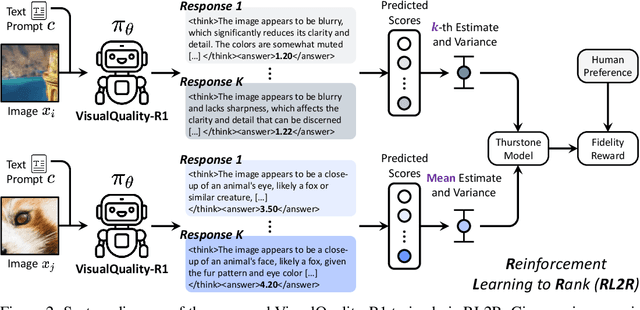
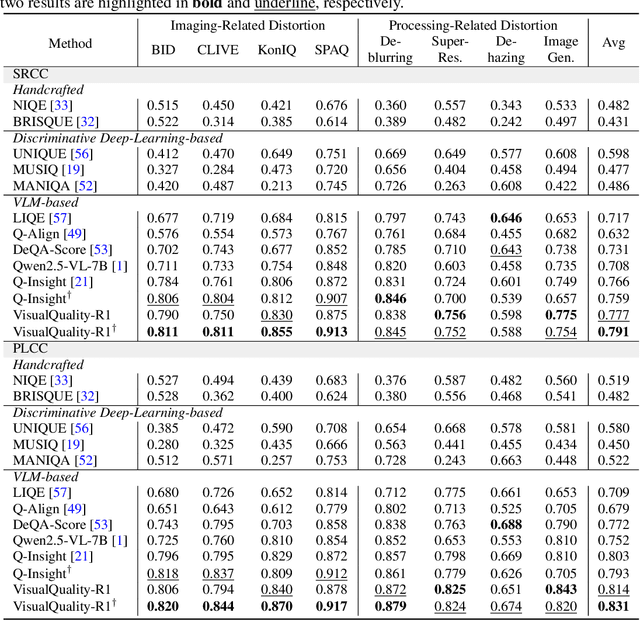

DeepSeek-R1 has demonstrated remarkable effectiveness in incentivizing reasoning and generalization capabilities of large language models (LLMs) through reinforcement learning. Nevertheless, the potential of reasoning-induced computational modeling has not been thoroughly explored in the context of image quality assessment (IQA), a task critically dependent on visual reasoning. In this paper, we introduce VisualQuality-R1, a reasoning-induced no-reference IQA (NR-IQA) model, and we train it with reinforcement learning to rank, a learning algorithm tailored to the intrinsically relative nature of visual quality. Specifically, for a pair of images, we employ group relative policy optimization to generate multiple quality scores for each image. These estimates are then used to compute comparative probabilities of one image having higher quality than the other under the Thurstone model. Rewards for each quality estimate are defined using continuous fidelity measures rather than discretized binary labels. Extensive experiments show that the proposed VisualQuality-R1 consistently outperforms discriminative deep learning-based NR-IQA models as well as a recent reasoning-induced quality regression method. Moreover, VisualQuality-R1 is capable of generating contextually rich, human-aligned quality descriptions, and supports multi-dataset training without requiring perceptual scale realignment. These features make VisualQuality-R1 especially well-suited for reliably measuring progress in a wide range of image processing tasks like super-resolution and image generation.